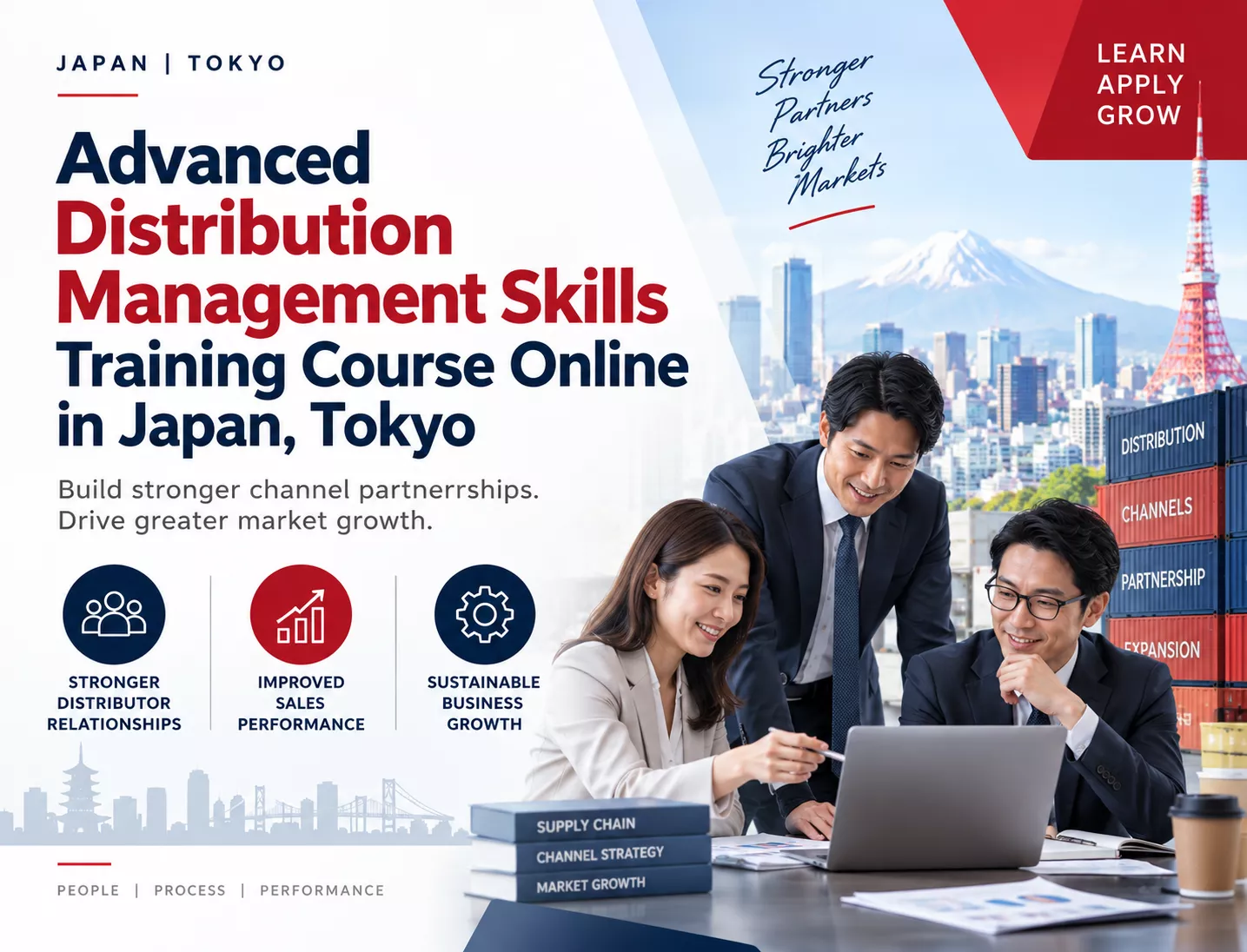
A strong distributor network can open markets, extend customer reach, and create new revenue opportunities. But appointing distributors is only the beginning. The real challenge is keeping partners engaged, aligned with business priorities, accountable for performance, and capable of representing your value in the market.
For companies operating in Tokyo and across Japan, advanced distribution management skills training can help sales and channel leaders move from simply supervising distributors to actively developing a high-performing indirect sales network.
Halifax Consulting provides Distribution Management Training for corporate teams, combining structured learning, practical workshops, digital learning, and personalized coaching. The program is built around real distribution challenges and can be delivered through online and in-person learning formats.
For sales directors, channel managers, partnership leaders, and professionals responsible for distributor performance, the focus is straightforward: build stronger partnerships and turn indirect channels into a more disciplined source of business growth.
Why Distribution Management Requires More Than Distributor Relationships
Having a good relationship with a distributor is valuable, but relationships alone do not guarantee results.
A distributor may represent several competing brands. Its salespeople may naturally prioritize products that are easier to sell, provide better margins, or receive greater support. Manufacturers may also have limited visibility into the distributor's pipeline and end customers.
These situations create practical questions for distribution managers:
How do you keep your brand high on the distributor's agenda? How should distributor performance be measured? What happens when targets are missed? How can managers motivate partners without relying entirely on discounts and incentives? And how do you develop a relationship that works for both sides over the long term?
Halifax Consulting's Distribution Management Training is designed around these kinds of challenges. Its objectives include partner onboarding, performance management, motivation, accountability, customer focus, KPIs, and continuous coaching.
Build the Skills to Lead a Distributor Network
Distribution managers occupy an unusual leadership position.
They are expected to influence performance, but the people they need to influence may not report directly to them.
That requires a different management skill set.
Successful channel leaders need to establish clear expectations, build commitment, conduct meaningful business reviews, identify performance gaps, and help partners improve their commercial execution.
The goal is not to control every activity performed by a distributor. It is to create a structure in which both companies understand what needs to be achieved and how progress will be measured.
Halifax's training helps participants develop this more structured approach to distributor leadership.
The ROCK Method® for Distribution Management
Halifax Consulting's Distribution Management Training is powered by its ROCK Method®, a framework developed to help managers coach, motivate, and manage distributor networks more effectively.
The approach brings structure to areas that can otherwise become informal or reactive.
Participants can strengthen the way they approach distributor roles and responsibilities, onboarding, partner development, coaching, performance measurement, and ongoing management.
This matters because distribution problems are rarely solved by one meeting or one new incentive.
Sustainable improvement requires a management rhythm: clear expectations, appropriate KPIs, regular reviews, constructive coaching, and agreed actions.
Improve Distributor Performance through Better KPIs
Sales numbers matter, but they do not always explain what is happening inside a distribution network.
If managers only look at final revenue, they may recognize a problem after valuable time has already been lost.
Effective distribution management therefore requires greater visibility into the activities and indicators that influence future performance.
Halifax's program addresses the use of data, KPIs, and continuous coaching to operationalize partner performance.
Depending on the company and distribution model, managers may need to examine pipeline development, customer coverage, product mix, market activity, conversion, partner engagement, joint initiatives, and other relevant indicators.
The objective is not to create unnecessary reporting. It is to give both sides useful information for better commercial decisions.
Move from Transactional Distribution to Strategic Partnership
A distributor relationship built mainly around orders, targets, and discounts can easily become transactional.
Strategic distribution management looks further ahead.
Halifax's own work on Key Account Management versus Distribution Management emphasizes longer-term partnership, multi-level relationships, joint business planning, regular reviews, and stronger visibility between suppliers and distributors.
This shift is particularly important when a distributor carries competing brands.
The supplier needs to create reasons for the partner to invest attention, resources, and sales effort in the relationship.
That can involve stronger joint planning; better sales enablement, improved market insight, management engagement, and helping the distributor create more value for its own customers.
When the relationship develops in this direction, the conversation becomes less about individual transactions and more about mutual growth.
Protect Value across Indirect Sales Channels
Price pressure is another major challenge in distribution.
If end customers push the distributor for lower prices, that pressure can quickly move upstream to the supplier. Constant discounting may protect individual deals in the short term while gradually weakening margins and perceived value.
Strong distribution managers therefore need to help partners sell more effectively rather than treating price reductions as the default solution.
This connects distributor management with value selling and negotiation capability.
Halifax's broader sales training portfolio includes both Value Selling and Strategic Negotiation, providing corporate teams with complementary capabilities when distribution challenges extend into value communication and commercial negotiations.
Online Distribution Management Training for Teams in Japan
Corporate training increasingly needs to work across offices, regions, and busy management schedules.
Halifax Consulting uses a blended learning approach rather than depending entirely on conventional classroom training.
Its Distribution Management Training can include preparatory meetings, e-learning modules, interactive workshops delivered online or in person, and one-to-one coaching with practical role-playing and feedback.
This format can be particularly useful for companies whose distribution managers are located across Japan or the wider APAC region.
Online learning does not have to mean passive presentations. Workshops, business cases, discussions, simulations, and coaching can keep the learning connected to situations participants actually manage.
Personalized Coaching for Real Distribution Challenges
Understanding a framework is one thing. Applying it to a difficult distributor is another.
A manager may be dealing with an underperforming partner, weak pipeline visibility, poor communication, competing brands, missed targets, or an uncomfortable business review.
Personalized coaching creates an opportunity to work through practical situations rather than keeping the learning theoretical.
Halifax incorporates one-to-one coaching and real-life role-playing into its blended Distribution Management Training approach.
Participants can practice important conversations, receive individual feedback, and examine how the principles learned during training apply to their own responsibilities.
Customized for Your Distribution Model
A company managing specialist industrial distributors will not have exactly the same requirements as a business working with franchise partners, resellers, dealers, or other indirect channels.
Training should reflect those differences.
Halifax begins its Distribution Management Training with preparatory work to tailor content to the client's distribution model. More broadly, Halifax states that its corporate programs are customized through immersion interviews and business cases adapted to the client's context.
That gives corporate organizations an opportunity to address the issues their teams actually encounter rather than working through generic examples with limited connection to their business.
Halifax also has senior consultants based in Tokyo, Japan, adding local presence to its wider APAC training capabilities.
Who Should Join a Distribution Management Training Course?
The program is particularly relevant for sales directors, distribution managers, channel managers, network managers, partnership leaders, franchise leaders, and professionals responsible for indirect sales channels.
It can also be valuable for experienced managers who already understand distribution but need a more systematic approach to partner performance, coaching, accountability, and joint business development.
For HR and L&D teams, the key question should therefore be less about whether participants are beginners or experienced managers and more about the business challenges the organization wants them to solve.
Why Consider Halifax Consulting for Distribution Management Training?
Halifax Consulting was founded in 2003 and expanded into Asia in 2016. Its current approach combines people, process, technology, blended learning, and practical sales methodologies developed around real-world commercial situations.
Distribution Management is a dedicated part of its Leadership Training & Coaching portfolio, rather than an isolated general-management topic. Halifax has also conducted dedicated KAM and Distribution Management masterclasses and has client experience with distributor-management development programs.
For companies in Japan, this provides access to a corporate training approach focused specifically on the realities of managing indirect sales performance.
Summary: Develop a Stronger Distribution Network in Japan
Effective distribution management is ultimately about getting better results through partners you do not directly manage.
That requires clear expectations, stronger partner engagement, meaningful KPIs, disciplined business reviews, coaching skills, joint planning, and the ability to turn distributor relationships into productive long-term partnerships.
Halifax Consulting's Advanced Distribution Management Skills Training brings these capabilities together through structured training, practical application, online learning options, and personalized coaching.
For companies looking for Distribution Management Training in Tokyo or Japan, the program can be customized around the organization's existing distribution model, partner challenges, team responsibilities, and commercial priorities.
Contact Halifax Consulting to discuss an online or customized Distribution Management Training program for your team in Japan.
Frequently Asked Questions
1. Is Halifax consulting’s Distribution Management Training available online in Japan?
Yes. Halifax uses a blended learning model that can include e-learning and interactive online workshops, alongside other learning formats such as in-person workshops and one-to-one coaching.
2. Who should attend the Distribution Management Training course?
The training is designed for professionals responsible for indirect sales performance, including sales directors, channel and network managers, partnership leaders, franchise leaders, and other professionals managing distributor networks.
3. What skills does the Distribution Management program develop?
The program focuses on areas such as distributor onboarding, partner motivation and accountability, customer-focused channel management, performance measurement, KPIs, coaching, and improving execution across indirect sales networks.
4. Can Halifax customize the training for our distributor network in Japan?
Yes. Halifax prepares its training around the client's distribution model, market situation, team, and partner challenges rather than applying exactly the same program to every organization.
5. How can our company inquire about Distribution Management Training in Tokyo or Japan?
Companies can contact Halifax Consulting Asia to discuss their distribution network, participant profiles, current partner-management challenges, and preferred training format. Halifax can then determine an appropriate customized learning approach for the team.

Jerome Teng